
Why Proper Warehouse Labelling Reduces Inventory Errors
A warehouse may contain hundreds or even thousands of products stored across different aisles, racks, shelves, pallets, and bins.
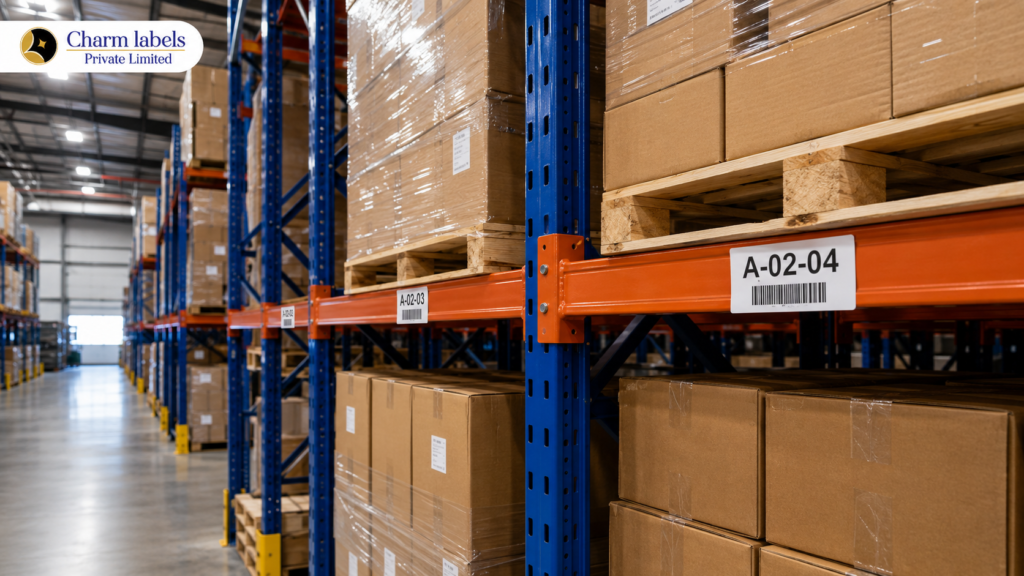
Proper warehouse labelling helps businesses avoid these problems by giving every storage location a clear identity. Aisles, racks, shelves, bins, pallets, and floor areas can all be marked using readable text, location codes, colours, barcodes, or QR codes. Therefore, employees can identify the correct storage area without relying only on memory.
In addition, a structured labelling system connects physical stock with digital inventory records. When a worker scans a location label before storing or picking an item, the warehouse management system can confirm whether the correct location has been selected. Consequently, stock movements become more accurate, faster, and easier to track.
For warehouses handling large stock volumes, proper labelling is not simply a design improvement. Instead, it is an essential part of inventory control, employee productivity, and customer satisfaction.
What Is Warehouse Labelling?
Warehouse labelling is the process of identifying storage locations, products, equipment, and operational areas using printed labels or signs. These labels may include letters, numbers, barcodes, QR codes, safety information, directional arrows, and colour codes.
For example, a warehouse location code such as A-04-R02-S03 may represent aisle A, section 4, rack 2, and shelf 3. Once employees understand the coding structure, they can locate any storage position quickly.
Different labels are used for different purposes. Large aisle signs guide employees from a distance, while rack labels identify specific pallet locations. Shelf and bin labels provide more detailed information for smaller products. Meanwhile, floor labels can mark loading areas, staging zones, walking paths, or temporary storage positions.
Because each location has a unique code, there is less confusion between similar-looking areas. Furthermore, barcode or QR code integration allows employees to scan locations and update inventory records immediately.
Common Causes of Inventory Errors
Inventory errors can occur for several reasons. In many cases, products are placed in the wrong location during receiving or put-away. A worker may be in a hurry and choose the nearest available shelf instead of the assigned storage area.
Poorly visible labels can also create mistakes. If a barcode is faded, damaged, too small, or blocked by stock, employees may scan the wrong label or enter the location manually. Similarly, handwritten labels may become difficult to read over time.
Another common problem is inconsistent location coding. One section may use letters and numbers, while another area follows a different format. Therefore, employees may struggle to understand the system, especially when they are new to the warehouse.
Inventory errors may also happen during picking. Products with similar packaging can be stored close together, making it easy for a worker to select the wrong item. Additionally, returned goods may be placed in an incorrect bin after inspection.
Although each mistake may appear minor, repeated errors can lead to stock shortages, excess inventory, delayed orders, and customer complaints.
Clear Labels Help Workers Find Products Faster
One of the biggest advantages of warehouse labelling is faster product identification. When aisles, racks, and shelves are clearly marked, workers do not need to spend time searching through different areas.
A picker can follow the location shown on a handheld device and move directly to the correct rack. Once there, a shelf label confirms the exact product position. As a result, unnecessary walking and repeated checking are reduced.
Large warehouses benefit even more from visible location labels. Employees may work across multiple zones, and remembering every product position is nearly impossible. Therefore, clear signage helps them navigate the facility with confidence.
Moreover, temporary workers and newly hired employees can understand the warehouse layout more easily. They do not have to depend on experienced workers for every location. Consequently, training becomes simpler and productivity improves sooner.
Proper Labelling Prevents Wrong Product Placement
Products must be placed in the correct location immediately after receiving. Otherwise, the inventory system may show one location while the physical item remains somewhere else.
Warehouse location labels reduce this risk by helping employees verify the assigned position before storing the product. A worker can scan both the product barcode and the location barcode. If the information does not match, the system can display an error message.
This verification process creates an additional layer of control. Instead of assuming that the location is correct, employees receive digital confirmation.
In addition, clearly labelled racks prevent workers from placing items in nearby empty spaces without updating the system. Although this may seem convenient at the time, unrecorded location changes can cause serious problems later.
When every put-away activity follows a labelled location system, physical stock is more likely to match the inventory records.
Picking Errors Are Reduced
Picking errors occur when employees collect the wrong product, quantity, batch, or size. These mistakes may not be discovered until the order reaches the packing area or, in some cases, the customer.
Proper warehouse labelling helps employees confirm that they are selecting products from the correct location. Barcode scanning can also verify the product and storage position before the item is removed.
For example, if two similar products are stored on neighbouring shelves, clear location labels make the difference easier to recognise. Colour coding may provide an additional visual guide, especially for product categories, temperature zones, or high-priority stock.
Furthermore, arrows can indicate whether the required location is above, below, left, or right. This feature is particularly useful on multi-level pallet racks.
As a result, workers make fewer selections from the wrong shelf, and packing teams receive more accurate orders.
How Proper Warehouse Labelling Reduces Inventory Errors
Clear warehouse labels help employees identify racks, shelves, bins, pallets, and storage zones quickly. As a result, businesses can reduce picking mistakes, improve stock accuracy, and manage warehouse operations more efficiently.
Accurate Stock Placement
Clearly printed location labels guide workers to the correct rack, shelf, or bin. Therefore, products are less likely to be stored in the wrong location.
Faster Product Picking
Readable location codes and barcode labels help employees find products faster. Moreover, picking routes become easier to follow.
Fewer Inventory Errors
Barcode scanning confirms both the product and storage location. Consequently, incorrect picking and placement errors are reduced.
Improved Stock Counting
Properly labelled warehouse locations make cycle counting and stock audits faster, more organised, and more accurate.
Better Productivity
Employees spend less time searching for stock. In addition, new workers can understand the warehouse layout more easily.
Organised Warehouse Space
Unique location labels help managers monitor occupied and empty storage positions while improving overall space utilisation.
Reliable Labels for Demanding Warehouse Conditions
Warehouse labels should remain readable despite dust, moisture, abrasion, temperature changes, and frequent handling. Durable materials, strong adhesives, and high-quality barcode printing help maintain reliable identification for longer periods.
Labelling Improves Employee Productivity
Warehouse productivity depends heavily on how quickly employees can complete daily tasks. Searching for missing products, correcting errors, and recounting stock can waste valuable time.
Clear warehouse labels reduce these delays. Workers can locate storage areas faster, scan information accurately, and move to the next task without confusion.
Additionally, supervisors receive fewer questions about product locations. Experienced employees also spend less time helping new workers navigate the warehouse.
Over time, these small improvements create a significant increase in productivity. More orders can be processed during the same working hours, and labour costs can be controlled more effectively.
Although labels are a simple warehouse tool, their impact can be seen across receiving, storage, picking, packing, and dispatch operations.
New Employee Training Becomes Simpler
Training new warehouse employees can be challenging when the facility does not have a clear location system.
A structured labelling format helps new workers understand how the warehouse is organised. For example, the first character may represent the aisle, while the next numbers indicate the rack, level, and bin.
Once the coding pattern is explained, employees can find locations independently. In addition, large aisle signs and colour-coded zones provide visual guidance.
Barcode scanning offers further support because the system can immediately confirm whether the employee is in the correct location. As a result, new team members can complete tasks with fewer mistakes.
Furthermore, standardised labels ensure that every employee follows the same process. This consistency is important when the warehouse operates across multiple shifts.
Proper Labels Help Organise Warehouse Space
Space management is another important benefit of warehouse labelling. When every storage position has a unique identity, managers can see which areas are occupied, empty, or underused.
Fast-moving products can be assigned to easily accessible locations near packing and dispatch areas. Meanwhile, slow-moving inventory can be stored farther away.
In addition, heavy products may be placed on lower rack levels, while lighter items are stored above. Labels ensure that employees follow these storage plans.
If products need to be moved, the new location can be updated in the system. Because the storage position has a clear label, employees can complete the transfer accurately.
Consequently, warehouse space is used more efficiently, and overcrowding can be reduced.
FIFO and FEFO Processes Become More Reliable
Many warehouses use FIFO or FEFO stock rotation methods. FIFO means first in, first out, while FEFO means first expired, first out.
These methods are especially important for food, beverages, cosmetics, pharmaceuticals, chemicals, and other products with expiry dates.
Proper labelling helps warehouses separate stock according to batch numbers, manufacturing dates, or expiry dates. Location codes can be linked to this information within the inventory system.
When an order is created, the system can direct the worker to the oldest or earliest-expiring batch. The employee then scans the correct location before picking.
Without accurate labels, newer stock may be picked first while older products remain unused. As a result, goods may expire and create unnecessary waste.
Therefore, warehouse labelling supports better stock rotation and reduces product loss.
Colour Coding Provides Faster Visual Identification
Colour coding can make warehouse locations easier to understand. Different colours may be used for separate zones, departments, product categories, or safety areas.
For example, green labels may identify finished goods, while yellow labels show items waiting for inspection. Red labels can indicate restricted or damaged stock.
Although colour is useful, it should not be the only method of identification. Printed text and barcodes are still necessary because colour perception can vary between employees.
However, when colour is combined with readable location codes, workers can recognise areas more quickly. This visual system is especially helpful in large warehouses with several storage sections.
Durable Labels Reduce Long-Term Mistakes
Warehouse labels are regularly exposed to dust, moisture, temperature changes, scratches, chemicals, and frequent handling. Therefore, the material and printing method must be selected carefully.
Paper labels may be suitable for clean and dry indoor areas. However, synthetic materials such as polypropylene, polyester, or vinyl offer better durability in demanding conditions.
Polyester labels can resist tearing and abrasion, making them suitable for industrial racks. Polypropylene labels provide good moisture resistance and clear barcode printing. Meanwhile, vinyl labels can work well on curved or uneven surfaces.
Cold storage facilities require labels and adhesives that remain stable at low temperatures. Similarly, outdoor storage areas need materials that can withstand sunlight and weather exposure.
Durable labels remain readable for longer periods. Consequently, workers are less likely to misread damaged codes or scan faded barcodes.
Barcode Quality Is Important
A warehouse barcode should scan quickly and accurately. Poor-quality printing can slow down workers and increase manual data entry.
Clear contrast between the barcode and background is essential. The barcode must also have the correct size, spacing, and blank area around it.
Thermal transfer printing is commonly used for warehouse labels because it can produce sharp and durable barcodes. Depending on the environment, wax, wax-resin, or resin ribbons may be selected.
Label placement is equally important. Barcodes should be installed at a height that employees can scan comfortably. If labels are placed too high, too low, or behind products, scanning becomes difficult.
Therefore, both print quality and positioning must be considered during warehouse label planning.
Safety and Operational Errors Are Reduced
Warehouse labels can also improve workplace safety. Floor markings may identify forklift routes, pedestrian paths, loading areas, and emergency exits.
Warning labels can mark hazardous materials, restricted zones, heavy-load racks, or temperature-controlled areas. As a result, employees understand where special precautions are required.
A well-organised warehouse is usually safer because products are stored in their assigned positions. Items are less likely to block walkways or be placed on unsuitable racks.
Furthermore, employees do not need to move around unnecessarily while searching for missing stock. This reduction in unnecessary movement can lower the risk of accidents.
Best Practices for Warehouse Labelling
A good warehouse labelling system should use a simple and consistent code structure. Employees must be able to understand the location format without confusion.
Fonts should be large enough to read from the required distance. At the same time, barcodes must be printed clearly and positioned for easy scanning.
Colour coding can be used to separate zones, but text and barcode information should always remain the main identification method.
Before installing labels across the warehouse, the material should be tested on the actual surface. Painted metal, plastic bins, wood, concrete, and powder-coated racks may require different adhesives.
Additionally, damaged or outdated labels should be replaced quickly. Regular inspections can prevent faded information from creating inventory errors.
Finally, employees should receive proper training. Even the best label system will not work effectively unless workers understand the coding structure and scanning procedure.
How Accurate Warehousing Improves Customer Satisfaction
Customers may not see the warehouse labelling system, but they experience its results.
Accurate picking means customers receive the correct product and quantity. Faster warehouse operations support shorter dispatch times, while reliable inventory records reduce order cancellations.
In addition, fewer errors lead to fewer returns, complaints, and replacement shipments. Businesses can save money while maintaining stronger customer relationships.
When stock information is accurate, sales teams can also provide reliable availability updates. Consequently, customer trust improves.
Therefore, proper warehouse labelling supports not only internal efficiency but also overall service quality.
Conclusion
Proper warehouse labelling plays a major role in reducing inventory errors. It helps employees find products faster, place stock correctly, avoid picking mistakes, and maintain accurate digital records.
Moreover, clear labels support stock counting, warehouse management systems, employee training, space organisation, and product rotation. Durable materials and high-quality barcodes also ensure reliable performance in demanding warehouse conditions.
A successful labelling system should include consistent location codes, readable fonts, clear barcodes, suitable colours, strong adhesives, and correct label placement. Regular maintenance and employee training are equally important.
Ultimately, warehouses cannot maintain accurate inventory without clear location identification. By investing in properly designed warehouse labels, businesses can reduce mistakes, improve productivity, control operational costs, and provide better service to their customers.
Warehouse Labelling FAQs
Learn how proper warehouse labelling improves stock accuracy, product identification, picking speed, and inventory control.
What is warehouse labelling?
Warehouse labelling is the process of identifying aisles, racks, shelves, bins, pallets, and storage zones using printed labels, location codes, barcodes, QR codes, or colour markers. As a result, employees can find and manage stock more accurately.
How does proper warehouse labelling reduce inventory errors?
Clear labels help workers confirm the correct storage location before placing or picking products. In addition, barcode scanning connects physical stock movements with digital inventory records, reducing incorrect placement, picking mistakes, and manual entry errors.
What information should be included on a warehouse location label?
A warehouse location label may include an aisle number, rack code, shelf level, bin number, barcode, QR code, directional arrow, or colour code. However, the information should remain simple, readable, and consistent throughout the warehouse.
Which label materials are suitable for warehouse use?
Paper labels may work well in clean and dry indoor areas. Meanwhile, polyester, polypropylene, and vinyl labels are better suited for environments exposed to moisture, dust, scratches, chemicals, or frequent handling.
Can warehouse labels work with barcode scanners?
Yes. Warehouse labels can be printed with barcodes or QR codes that work with handheld scanners and warehouse management systems. Consequently, workers can verify locations quickly and update inventory records more accurately.
Where should warehouse labels be placed?
Labels should be placed where workers can easily see and scan them. Common positions include rack beams, shelf edges, storage bins, pallet locations, aisle entrances, and floor zones. Moreover, labels should not be blocked by products or equipment.