How Thermal Barcode Labels Improve Inventory and Product Tracking
Managing inventory accurately is one of the most important responsibilities for businesses that handle physical products.
warehouse, manufacturing unit, pharmacy, supermarket, logistics centre, or e-commerce business, every item must be identified and tracked correctly. Even a small mistake in product identification can lead to stock shortages, delayed deliveries, incorrect orders, and unhappy customers.
Thermal barcode labels offer a practical solution to these challenges. They allow businesses to print clear, scannable information directly onto labels and attach them to products, cartons, shelves, pallets, or packages. As a result, employees can locate products faster, update stock records accurately, and manage daily operations more efficiently.
Unlike handwritten labels, barcode labels reduce confusion and support automated tracking. Moreover, they help companies maintain reliable data throughout the product journey, from manufacturing and storage to shipping and final delivery.
What Are Thermal Barcode Labels?
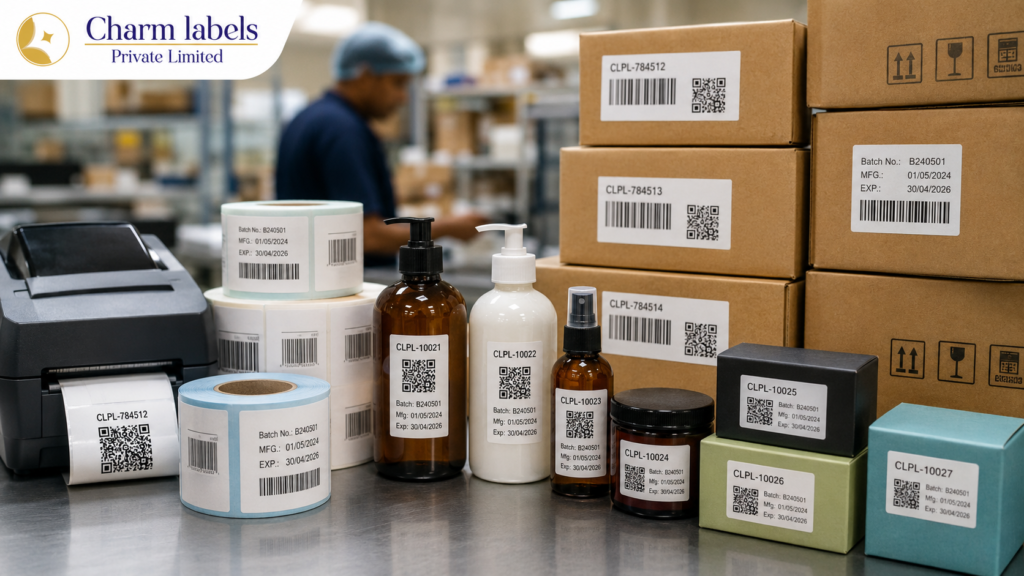
Thermal barcode labels are labels designed for printing through thermal printers. These printers use heat to create text, numbers, graphics, and barcodes on the label surface. Since the printing process is quick and efficient, thermal labels are widely used in environments where many labels must be produced every day.
There are two common types of thermal printing: direct thermal printing and thermal transfer printing.
Direct thermal labels contain a heat-sensitive coating. When the printer head applies heat, the required image appears on the label. No ink, toner, or ribbon is required during this process. Therefore, direct thermal labels are convenient for short-term applications such as shipping labels, receipts, food packaging, and temporary inventory identification.
Thermal transfer labels, however, use a printing ribbon. Heat from the printer head transfers the ribbon ink onto the label material. Because the printed image is more durable, thermal transfer labels are often selected for long-term product identification, warehouse tracking, asset management, outdoor use, and industrial applications.
The right option depends on the product, storage conditions, required lifespan, and printing environment.
Why Accurate Inventory Tracking Matters
Inventory information must match the actual number of products available in storage. When records are inaccurate, businesses may order unnecessary stock or fail to replace fast-moving products. Consequently, both excess inventory and stock shortages can affect profitability.
Accurate tracking also improves customer service. For example, when an online store displays that a product is available, the item should actually be present in the warehouse. If the stock record is incorrect, the company may accept an order that it cannot fulfil.
Manual inventory management makes these errors more likely. Employees may enter incorrect product codes, overlook items, or write unclear information. In contrast, barcode-based systems simplify product identification. A quick scan can capture the required information without entering every detail manually.
Thermal barcode labels therefore create a strong connection between physical products and digital inventory records.
Improved Inventory Accuracy
Human errors can happen during data entry, stock counting, or order processing. However, thermal barcode labels reduce the need for repeated manual information entry.
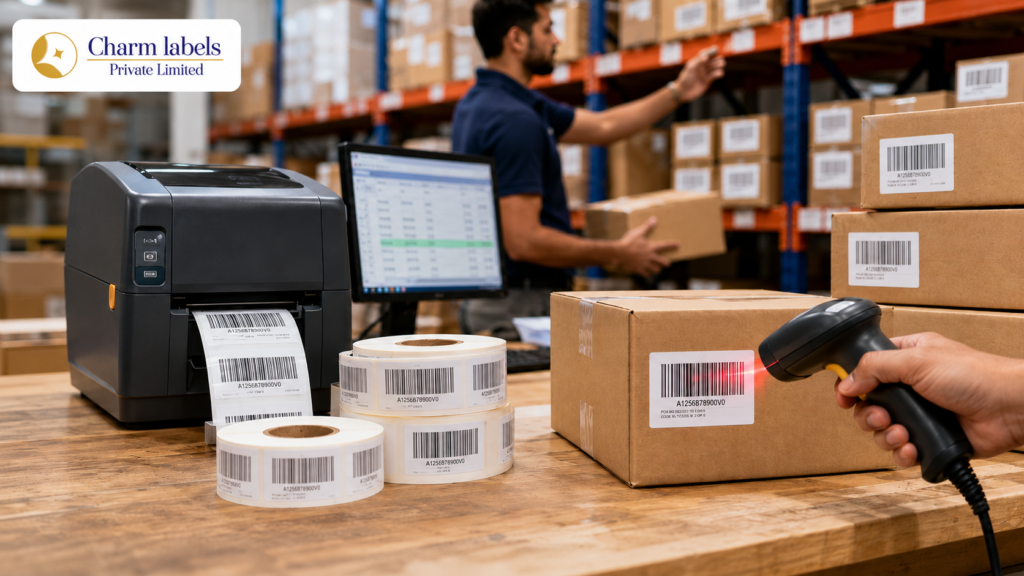
When a product arrives at a warehouse, its barcode can be scanned and added to the inventory system. Later, the same label can be scanned again when the product is moved, sold, packed, or shipped. Each scan updates the product status and helps maintain accurate records.
For instance, if twenty cartons are dispatched, scanning each carton allows the system to reduce the available quantity automatically. Therefore, inventory data remains closer to the actual physical stock.
Regular scanning also supports faster stock audits. Instead of writing product details manually, employees can scan labels and compare the information with system records. Consequently, businesses can identify missing, misplaced, or damaged products more efficiently.
Better Warehouse Organisation
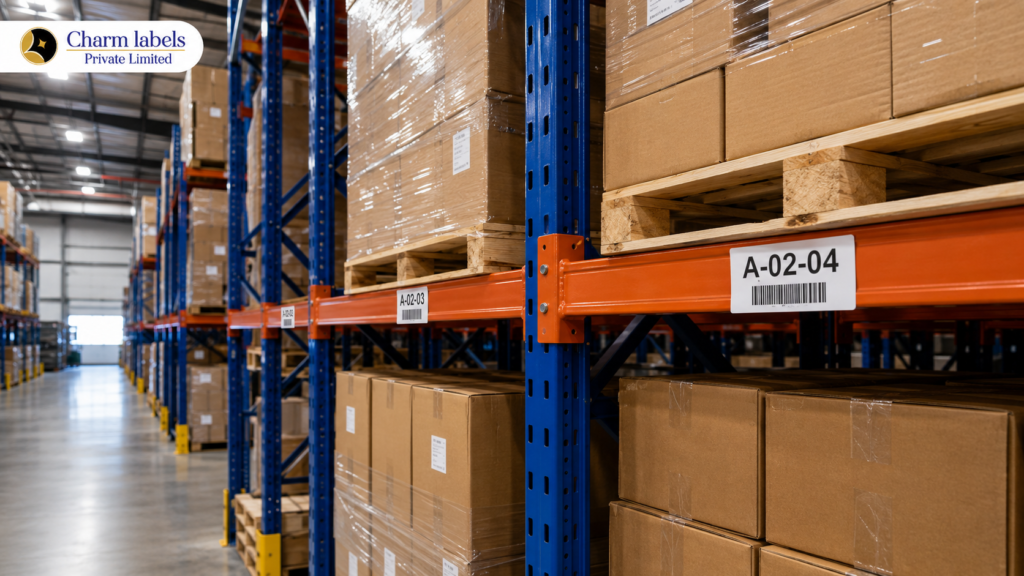
Warehouse organisation becomes easier when every product, shelf, rack, and storage location has a unique barcode label. Labels can be used not only on products but also on bins, pallets, containers, and warehouse sections.
When goods arrive, employees can scan the product barcode and the assigned storage location. This process records exactly where the item has been placed. Later, workers can use the inventory system to find the product without searching the entire warehouse.
Additionally, location labels help new employees work more confidently. They do not need extensive knowledge of the warehouse layout because the barcode system guides them towards the correct section.
A well-organised warehouse also reduces unnecessary movement. Since employees spend less time searching for items, order preparation becomes faster and more efficient.
Smooth Receiving and Stock Entry
Receiving inventory is an important stage because incorrect entries at this point can affect all later operations. Thermal barcode labels help simplify the process.
Products may arrive with supplier barcodes, or businesses may print their own internal labels. After checking the shipment, staff can attach the required barcode label and scan the item into the inventory system.
This approach allows the company to record essential details such as quantity, batch number, supplier, receiving date, and storage location. Moreover, barcode scanning can help employees compare received items with purchase orders.
If the quantity does not match the order, the difference can be identified immediately. Therefore, problems are corrected before the goods enter storage.
Faster Order Picking and Packing
Order picking is often one of the most time-consuming warehouse activities. Employees must find the correct products, verify quantities, and move them to the packing area. Thermal barcode labels make each step easier.
First, the inventory system provides the product code and storage location. Next, the employee scans the item to confirm that it matches the order. If the wrong product is selected, the system can show an alert before packing begins.
During packing, another scan can verify that all required products are included. As a result, the risk of sending incorrect items to customers is reduced.
Fewer packing errors mean fewer returns, replacements, and customer complaints. In addition, businesses can process more orders within the same working period.
Benefits of Thermal Barcode Labels
Thermal barcode labels help businesses track products accurately, reduce manual errors, and improve warehouse operations. Clear barcode printing also supports faster scanning during storage, packing, and dispatch.
Faster Product Tracking
Barcode scanning helps employees identify products quickly without manually entering product codes or searching through records.
Better Stock Accuracy
Every product movement can be recorded through scanning, helping businesses maintain accurate and updated inventory information.
Reduced Human Errors
Thermal barcode labels reduce mistakes caused by handwritten labels, incorrect product codes, and repeated manual data entry.
Smooth Warehouse Operations
Labels can be applied to products, cartons, racks, bins, and pallets to support organised storage and faster order processing.
Reliable Product Tracking Throughout the Supply Chain
Products often pass through several stages before reaching the customer. They may move from manufacturing to storage, distribution, retail, and final delivery. Thermal barcode labels help businesses track these movements.
Each scan creates a digital record of the product’s location or status. Therefore, companies can understand when an item was manufactured, where it was stored, when it was shipped, and whether it reached the intended destination.
This visibility is especially useful for logistics and distribution businesses. If a shipment is delayed, the latest scan can help identify its last recorded location.
Furthermore, barcode tracking supports better communication between departments. Warehouse teams, sales staff, delivery partners, and customer service teams can access more reliable product information.
Batch and Expiry Date Management
Industries such as food, beverages, pharmaceuticals, cosmetics, and personal care require careful batch and expiry date tracking. Thermal barcode labels can include batch numbers, manufacturing dates, and expiry information in both readable text and barcode format.
Employees can scan these labels to identify products approaching expiry. Consequently, businesses can prioritise older stock and follow the first-expiry-first-out method where required.
Batch tracking is also important when a quality issue occurs. Instead of checking every product manually, the company can identify items linked to a specific batch. This makes product isolation or recall management faster and more organised.
Clear thermal printing ensures that important information remains readable during storage and handling. However, the correct label material and printing method must be selected based on the expected product lifespan.
Reduced Labour and Operational Costs
Barcode systems require an initial investment in printers, scanners, software, and labels. Nevertheless, they can reduce long-term operational costs.
Employees spend less time writing labels, entering product codes, searching for items, correcting mistakes, and performing manual stock checks. In addition, faster order processing allows businesses to handle higher volumes without significantly increasing staff requirements.
Thermal printers are also efficient because direct thermal printing does not require ink or toner. Thermal transfer printing requires a ribbon, but it provides durable results for demanding applications.
By selecting the right printing method, companies can balance label cost, durability, and performance.
Clear and Scannable Print Quality
Barcode performance depends heavily on print clarity. Blurred lines, poor contrast, scratches, or damaged labels can prevent scanners from reading the code correctly.
Thermal printing produces sharp barcodes when the printer, label material, ribbon, and settings are properly matched. As a result, scanning becomes faster and more reliable.
Consistent label dimensions are equally important. Labels must fit the product or packaging surface without folding over edges or covering important information. Moreover, adequate spacing around the barcode helps scanners recognise it easily.
For products exposed to moisture, oil, chemicals, heat, or rough handling, durable synthetic materials may be necessary. Meanwhile, standard paper labels may be suitable for indoor and short-term applications.
Choosing the Right Thermal Barcode Labels
Not every thermal label is suitable for every application. Businesses should consider the storage environment, printing method, surface type, label lifespan, and scanning requirements before ordering labels.
Direct thermal labels may be ideal for shipping labels and temporary identification. However, they can be affected by heat, sunlight, and long storage periods.
Thermal transfer labels are generally more suitable for durable applications. Depending on the material and ribbon, they can resist moisture, abrasion, chemicals, and temperature changes.
Adhesive selection also matters. Permanent adhesives provide strong bonding, while removable adhesives allow labels to be removed more easily. For cold storage, oily containers, curved surfaces, or rough cartons, specialised adhesives may be required.
Testing the label on the actual product surface is therefore recommended before large-scale production.
Best Practices for Using Thermal Barcode Labels
Businesses can improve label performance by following a few practical steps.
First, choose label dimensions that match the packaging and printer specifications. Next, ensure that the barcode size and contrast support reliable scanning. The printer head should also be cleaned regularly to prevent faded lines or printing gaps.
Additionally, label rolls must be stored away from excessive heat, moisture, dust, and direct sunlight. Proper storage helps protect both the label material and adhesive quality.
Using high-quality barcode data is equally essential. Each barcode should represent the correct product or inventory record. Duplicate or incorrect codes can create confusion even when the print quality is excellent.
Finally, employees should be trained to scan items at every important movement point. A barcode system is most effective when scanning procedures are followed consistently.
Final Thoughts
Thermal barcode labels provide a simple but powerful way to improve inventory and product tracking. They help businesses identify products faster, maintain accurate stock records, organise warehouses, process orders efficiently, and monitor goods throughout the supply chain.
Moreover, barcode labels reduce manual errors and support better decision-making. Companies can understand what products are available, where items are stored, and when stock must be replaced.
The overall result is a smoother inventory process, fewer operational mistakes, and improved customer satisfaction. However, businesses must select the correct label material, adhesive, printing method, and barcode design for their specific environment.
With properly printed thermal barcode labels and a consistent scanning system, businesses can gain better control over inventory while saving valuable time and resources.
Thermal Barcode Labels FAQ
Find answers to common questions about thermal barcode labels, printing methods, materials, durability, and inventory tracking applications.
What are thermal barcode labels?
Thermal barcode labels are labels printed using heat-based printing technology. They are commonly used for product identification, inventory tracking, shipping, retail billing, warehousing, and logistics operations.
What is the difference between direct thermal and thermal transfer labels?
Direct thermal labels use heat-sensitive material and do not require a ribbon. Thermal transfer labels use a ribbon to produce more durable prints that can resist moisture, scratches, chemicals, and long-term handling.
How do thermal barcode labels improve inventory tracking?
Thermal barcode labels allow employees to scan products during receiving, storage, picking, packing, and dispatch. Each scan helps update stock records, reduce manual data entry, and improve inventory accuracy.
Which industries use thermal barcode labels?
Thermal barcode labels are widely used in retail, supermarkets, manufacturing, warehouses, logistics, pharmaceuticals, healthcare, food and beverage, garment, e-commerce, and distribution industries.
Are thermal barcode labels suitable for long-term use?
Thermal transfer labels are suitable for long-term applications because they offer stronger resistance to fading, abrasion, moisture, heat, and chemicals. Direct thermal labels are generally better for short-term applications.
Can thermal barcode labels be customised?
Yes. Thermal barcode labels can be customised in different sizes, shapes, materials, adhesive types, roll specifications, barcode formats, and core sizes based on printer and application requirements.